

By Christine Fryatt, RN, FMP-BC
You’ve hit a wall. Not the kind you push through with an extra cup of coffee and a good night’s sleep. The type where you wake up already exhausted, drag yourself through the day running on fumes, and collapse into bed only to stare at the ceiling, wondering why your body has completely stopped cooperating.
Someone tells you your symptoms sound like burnout, and someone else mentions adrenal fatigue. You Google both, then go through a rabbit hole of conflicting information, ending up more confused than when you started.
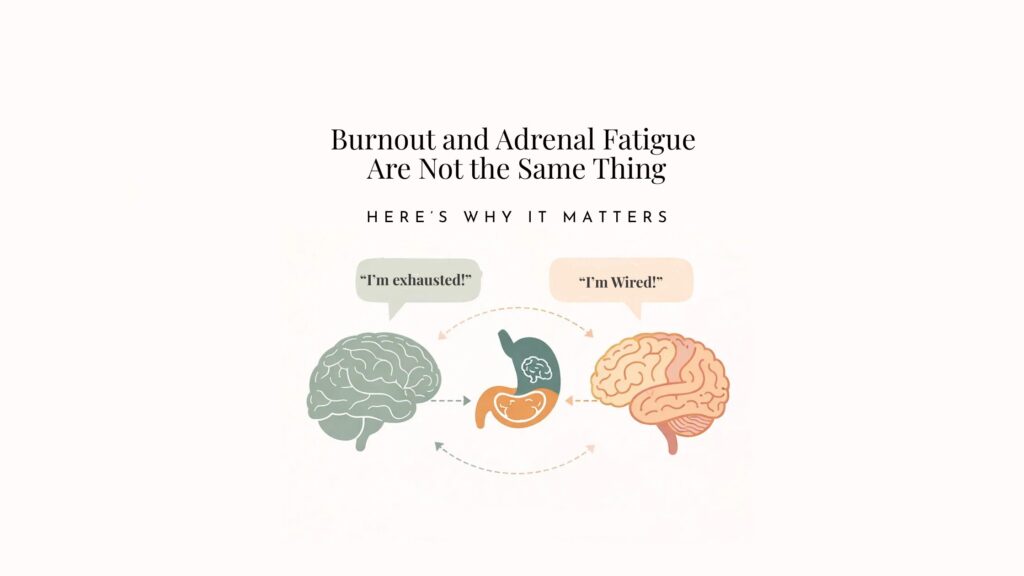
Here’s the truth: burnout and adrenal fatigue are related; they often overlap, but they are not the same thing. Treating them as the same can delay the proper support and leave someone spending years trying to recover without any progress.
Let’s sort this out.
What Burnout Actually Is
Burnout is not a personality flaw, laziness, a sign you’re not grateful enough, don’t meditate enough, or need a vacation.
Burnout is a state of chronic stress that has exceeded your capacity to recover. It was formally defined by the World Health Organization in 2019 as an occupational phenomenon, meaning it derives from prolonged, unmanaged workplace stress. Most clinicians and researchers now recognize that it extends well beyond the workplace into caregiving, chronic illness, and broader life circumstances.
There are three defining features of burnout:
Exhaustion that is physical, emotional, and cognitive all at once. This is not tiredness; it is a deep depletion that rest cannot reach, because the source of the drain has not been removed.
Depersonalization or cynicism happens when someone puts distance between themselves and the things and people that used to matter. This could be a job you loved that now fills you with dread. The relationships that sustained you now feel like obligations. This process is a form of detachment that is working as a defensive strategy, not a character change or flaw.
Reduced sense of efficacy. This is the creeping feeling that nothing you do makes a difference anymore, and your feeling of purpose is gone. Motivation collapses not because you’ve stopped caring but because your nervous system has learned, through repeated overwhelm, that effort doesn’t produce results.
Burnout is primarily a mental and neurological phenomenon that lives in the brain. Burnout specifically affects the prefrontal cortex along with the amygdala, and changes the way your stress response processes demands, threats, and recovery. Your thinking brain essentially goes offline while your threat-detection system runs hot 24 hours a day. That is why the distinction from adrenal fatigue matters.
What Adrenal Fatigue Actually Is
Adrenal fatigue is a term used a lot in functional and integrative medicine circles, and it is dismissed just as often in conventional medicine. The disagreement is worth understanding because both sides are partially right.
Your adrenal glands sit on top of your kidneys, like little hats, and produce a number of important hormones, including cortisol, your primary stress hormone. When your body perceives stress, your adrenal glands release cortisol to mobilize energy, sharpen focus, and manage the threat. This is a brilliant system when stress is acute and occasional. It becomes a problem when stress is chronic and unrelenting.
The conventional medical system says that actual adrenal insufficiency occurs when the adrenal glands fail to produce adequate cortisol, a serious condition called Addison’s disease, and it is diagnosed on standard lab tests. “Adrenal fatigue” as a diagnosis does not appear in conventional medical literature because the glands themselves are not typically failing.
What functional and integrative medicine practitioners mean when they use the term is something more complex. It is described as a dysregulation of the HPA axis, the hypothalamic-pituitary-adrenal axis, which is the communication system that instructs your brain to signal your adrenal glands to produce cortisol.
In HPA axis dysregulation, the problem is not that your adrenal glands have stopped working; instead, the signaling system has become dysregulated after prolonged stress exposure. Cortisol patterns that are expected to follow a predictable daily rhythm, showing higher in the morning to support waking and alertness, tapering through the day, and low at night to allow sleep, become flattened, inverted, or unstable.
The result is a very real set of symptoms that standard lab panels often miss because they’re measuring the wrong thing at the wrong time. That sets up the overlap with burnout, where the picture becomes even more confusing.
Where They Overlap — and Where They Diverge
This is where it gets important. The overlap is exactly why these two problems are so often confused.
Burnout and HPA axis dysregulation almost always occur together. Chronic psychological stress, the kind that produces burnout, is precisely the kind of input that changes cortisol signaling over time. You cannot sustain years of high-demand, low-recovery living without your stress hormone system adapting in ways that eventually work against you.
But they are not the same problem, and they do not have the same solution. To see why, it helps to separate what is upstream from what is downstream.
Burnout is upstream. It is chronic stress inputs such as the impossible workload, caregiving without support, an identity built entirely on productivity, and years of pouring out without refilling. Addressing burnout means addressing the source and the pattern. It requires psychological and nervous system work, such as boundary-setting, identity restructuring, processing what got you here, and rebuilding a relationship with rest that isn’t just collapsing between life’s obligations.
HPA axis dysregulation occurs downstream. It is what happens in the body after years of that upstream stress. It requires physiological support, including sleep, nutrition, movement that restores rather than depletes, and sometimes targeted supplementation or testing to understand where your cortisol rhythm has gone haywire. Addressing it without addressing burnout is like bailing water out of a sinking boat without a plug; the symptoms keep returning.
The symptoms that look identical in both:
- Profound fatigue that doesn’t respond to sleep
- Difficulty waking in the morning despite adequate hours in bed
- Energy dips in the afternoon
- Wired but tired: exhausted at night but unable to fall asleep
- Craving salt and sugar
- Reduced stress tolerance, small things feel enormous
- Brain fog and poor concentration
- Getting sick repeatedly
The symptoms more specific to burnout:
- Emotional numbness or detachment
- Loss of meaning and motivation
- Resentment toward work, caregiving, or responsibilities that used to feel purposeful
- A sense that you have disappeared somewhere inside your own life
The symptoms more specific to HPA dysregulation:
- Symptoms that follow a pattern related to time of day
- Dizziness when standing up quickly
- Blood sugar instability: feeling shaky, irritable, or foggy when meals are delayed
- Sensitivity to light and noise beyond what stress alone explains
- Slow recovery from illness or physical exertion
Why This Distinction Matters for Recovery
If you treat burnout like it’s purely a cortisol problem, you’ll spend a fortune on adaptogens and supplements and feel marginally better without ever addressing why you burned out in the first place. The pattern continues. The depletion continues, and the same life setup keeps draining you.
If you treat HPA dysregulation like it’s purely a mindset problem, you’ll do all the journaling and boundary-setting and therapy in the world while your physiology is actively undermining your recovery. Rest doesn’t restore you when your cortisol rhythm is inverted. Motivation doesn’t return on command when your stress hormones are flatlined, so progress halts.
Recovery from both requires working at both levels simultaneously and in the right order. First, address what is driving the stress; then support the body’s response to it.
Start here:
Remove or reduce the stressor where possible. This sounds obvious, but it’s frequently skipped because it requires hard decisions. If the source of chronic stress is still running at full volume, recovery is not possible; it is only being managed.
Prioritize sleep above almost everything else. Cortisol rhythm recovery relies on steady sleep and wake times. Not perfect sleep. Consistent timing. Your body uses light exposure and sleep-wake cycles to begin rebalancing the HPA axis. This is really important.
Eat in a way that stabilizes blood sugar. Cortisol dysregulation and blood sugar instability are deeply linked. Skipping meals, relying on caffeine, and eating high-sugar foods without protein and fat all worsen HPA dysfunction. Three balanced meals at consistent times do more for adrenal recovery than most supplements.
Movement, but not in a way that causes more stress and depletion. High-intensity exercise is an additional stressor. While in active burnout and HPA dysregulation, high-intensity exercise often makes things worse. Walking, gentle yoga, swimming, and stretching are movements that bring your nervous system down, not up.
Consider testing before supplementing. A four-point salivary cortisol test taken at multiple points throughout the day gives a far more accurate picture of your cortisol rhythm than a single blood draw. If you’re going to address HPA dysregulation physiologically, knowing what your pattern actually looks like is worth the investment.
Do the psychological work in parallel. Burnout does not resolve on its own through physical recovery alone. The beliefs, patterns, and circumstances that produced it need to be examined. This is not optional, and it is not a sign of weakness. It is the upstream work that keeps the downstream physiology from dysregulating again and/or staying dysregulated.
You Are Not Just Tired
There is a version of this story where you keep going, keep caffeinating, keep telling yourself you just need to get through, like telling yourself “this too shall pass,” and five years from now you are in the same place, more depleted, more confused about why nothing works, and farther from feeling like yourself.
Choose the version where you understand what is actually happening in your body and your nervous system, make decisions from that understanding, and give yourself a real path back.
Burnout and adrenal fatigue are not character flaws. They are not inevitable. They are what happens when a human being runs at unsustainable output for too long without the ability to rest and recover adequately, essentially burning the candle at both ends. This can be reversed by addressing both what happened in your mind and the resulting changes in your body.
You are not just tired. You are depleted at a systems level. And systems recover with the right inputs.
Christine Fryatt is a registered nurse and board-certified functional medicine practitioner (FMP-BC) with 20+ years of clinical experience in population health, case management, behavioral health, and integrative wellness. She writes evidence-based health content for people who want real answers, not just reassurance. Find more at christinefryattrn.com.
Leave a Reply