

By Christine Fryatt, RN, FMP-BC
You’re exhausted in a way that sleep doesn’t fix. You’re anxious for no reason you can name. Your stomach is a disaster — bloated, unpredictable, uncomfortable — and yet every lab panel comes back “normal.” Your doctor is not concerned. You, however, are very much.
If this sounds familiar, you’re not imagining things. And you’re not broken. But there’s a good chance the two problems you’ve been treating separately are actually one conversation happening in the wrong direction.
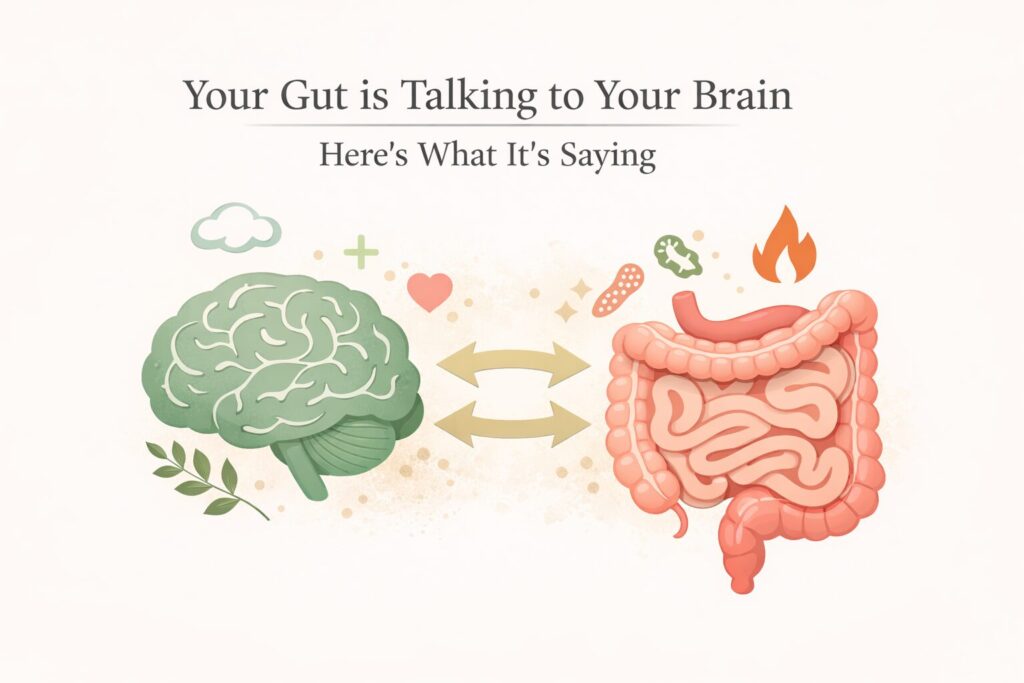
Your gut and your brain are constantly talking to each other. The question is whether that conversation is helping or harming you—and what to do when it goes sideways.
The Second Brain You Never Knew You Had
Here’s something that gets left out of most doctors’ appointments: your gut has its own nervous system.
It’s called the enteric nervous system, and it contains roughly 500 million nerve cells lining your gastrointestinal tract from your esophagus to your colon. It can sense, process, and respond to information entirely on its own — without waiting for instructions from your brain. Scientists have called it “the second brain” for decades, and the nickname stuck because it’s accurate.
These two brains — the one in your skull and the one in your gut — stay in constant contact through a communication superhighway called the vagus nerve. The vagus nerve runs from your brainstem all the way down through your chest and into your abdomen, carrying signals in both directions. Stress signals travel down. Gut status reports travel up. When either system is struggling, the other one hears about it.
Here’s the part that tends to stop people cold: approximately 90% of your body’s serotonin is produced in your gut — not your brain. Serotonin is the neurotransmitter most associated with mood, emotional stability, and feelings of well-being. So when someone tells you that your anxiety or depression is “just a chemical imbalance in your brain,” they’re leaving out a significant part of the picture.
Your gut isn’t just digesting your lunch. It’s helping regulate your mood, stress response, sleep, and cognitive function. The takeaway: gut health affects how you feel and function every day.
What Throws the Whole System Off
The gut–brain connection is remarkably resilient — until it isn’t. And in modern life, it takes a beating from several directions at once.
Chronic stress is probably the biggest disruptor. When your nervous system is stuck in fight-or-flight mode — which for many women means basically all the time — your body redirects resources away from digestion. Cortisol, the primary stress hormone, damages the gut lining over time, increases intestinal permeability (what some people call “leaky gut”), and alters the composition of your gut microbiome. Stressed gut, stressed brain. Stressed brain, stressed gut. The cycle feeds itself.
Antibiotic use has saved many lives while quietly devastating millions of microbiomes. A single course of antibiotics can wipe out beneficial bacterial strains that take months or years to recover — if they recover at all. Most of us have had multiple courses over our lifetimes with little to no guidance on rebuilding afterward.
Ultra-processed foods have replaced whole foods in the modern diet at a staggering rate. The gut microbiome — the community of trillions of bacteria, fungi, and other microorganisms living in your digestive tract — requires diversity and fiber to thrive. Processed food delivers neither. Reduced microbial diversity is now linked to everything from depression and anxiety to autoimmune conditions and metabolic disease.
Poor sleep closes the loop in the worst way. Sleep disruption alters gut microbiome composition. Gut microbiome disruption worsens sleep quality. If you’re lying awake at 3am with a racing mind and a churning stomach, this is not a coincidence.
None of this is a character flaw. It is a system under extraordinary load, which means the goal is to support it, not blame yourself for it.
How to Know If This Is Your Problem
The tricky thing about gut-brain dysfunction is that the symptoms show up in two places at once — and conventional medicine tends to treat each location separately.
On the gut side, you might notice bloating that seems unrelated to what you eat, irregular bowel habits, reflux or heartburn, cramping, or a growing list of foods that don’t seem to agree with you anymore. The pattern often starts with one symptom and widens over time.
On the brain and mood side, you might notice anxiety that feels free-floating and hard to explain, then persistent low mood, brain fog that makes simple tasks appear difficult, fatigue that doesn’t respond to rest, intense sugar or carbohydrate cravings, or sleep that is technically happening but not restoring you.
What connects them is nervous system dysregulation and microbiome disruption happening underneath both sets of symptoms. The takeaway is that one system can drive both gut and mood issues.
If you’ve been in GI workups that find nothing, or on anxiety medication that helps but doesn’t resolve things, or told your fatigue is just stress — and yet nothing fully resolves — this connection is worth understanding. Treating the gut and the brain as two separate problems, when they’re actually one system in distress, is why so many people stay stuck. The takeaway: look at the whole system, not one symptom at a time.
Five Places to Start
This is not a protocol. It’s not a supplement stack. It’s five places to begin shifting the system — focused, accessible, and sustainable if you approach them one at a time rather than all at once.
- Eat for microbial diversity. The research on gut health keeps pointing back to one thing: variety. Specifically, aiming for around 30 different plant foods per week — vegetables, fruits, legumes, whole grains, nuts, seeds, herbs, and spices all count. You don’t need to overhaul your entire diet. You need to add variety. More colors, more types, more fiber. Your microbiome rewards range.
- Regulate your nervous system before you try to fix your gut. This one is mandatory and almost always skipped. You cannot successfully heal a gut that is operating inside a body stuck in chronic stress. The gut lining does not repair, digestion does not function optimally, and the microbiome does not stabilize when cortisol is chronically elevated. Nervous system regulation — slow diaphragmatic breathing, gentle movement, reducing the pace of meals, vagal toning practices — is not optional self-care. It is foundational medicine for gut health.
- Choose fermented foods over probiotic supplements. Probiotic supplements have their place, but the research on whole fermented foods is consistently stronger. Kefir, plain yogurt with live cultures, sauerkraut, kimchi, miso, and kombucha deliver diverse live bacterial strains along with the nutrients that support their survival. Start with one small serving daily and build from there. If you have significant gut issues, go slow — more is not always better at first.
- Treat sleep like medicine. The gut microbiome does significant repair and rebalancing work during sleep. Consistently short or disrupted sleep is one of the fastest ways to undermine gut health, which, in turn, further harms sleep quality. Protecting sleep — both its duration and timing consistency — is one of the highest-leverage things you can do for this entire system.
- Add before you restrict. The instinct with gut problems is usually to start removing things — gluten, dairy, FODMAPs, whatever is currently getting blamed on the internet. Elimination has its place, but starting there frequently leads to a more restrictive diet that fails to address the underlying environment. Before you remove, add: more fiber, more fermented foods, more variety, more rest, more nervous system support. Build the foundation first. Restriction, if needed, becomes much clearer from that vantage point.
A Different Way to Look at This
Your gut is not your enemy. It is not randomly malfunctioning. It is responding — logically and predictably — to the inputs it has been given and the environment it has been living in.
The bloating, the anxiety, the brain fog, the fatigue — these are not separate problems conspiring against you. They are one system communicating clearly, if loudly, that something needs to change.
You don’t need a perfect diet, a flawless supplement protocol, or another lab panel. You need to understand the system well enough to start working with it instead of against it.
Your gut has been talking to your brain this whole time. Now you know what it’s saying — and the next step is to respond by supporting the whole system.
Christine Fryatt is a registered nurse and board-certified functional medicine practitioner (FMP-BC) with 20+ years of clinical experience in population health, case management, behavioral health, and integrative wellness. She writes evidence-based health content for people who want real answers, not just reassurance. Find more at christinefryattrn.com.
Leave a Reply